


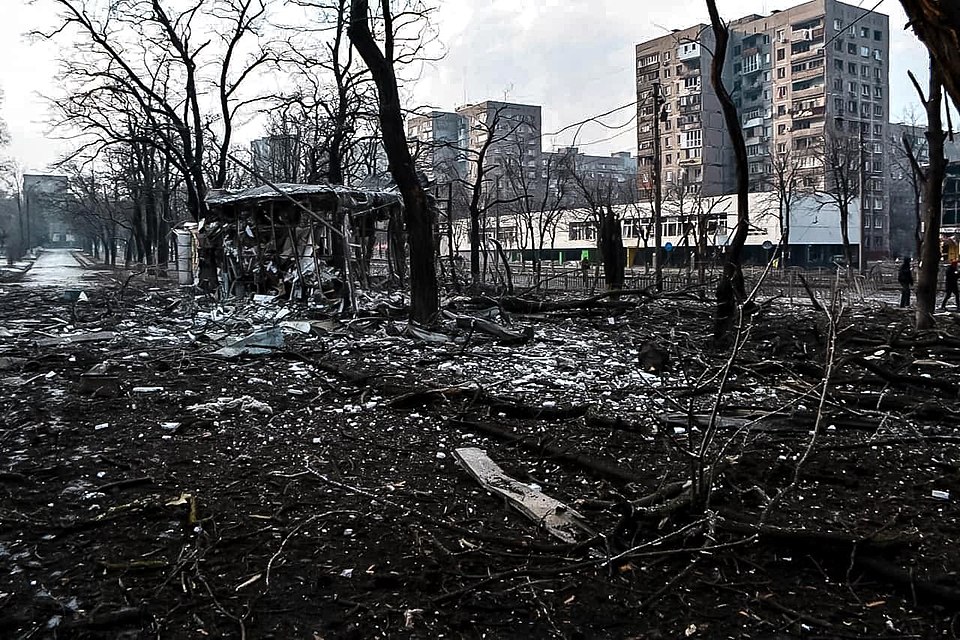
This blog is based on work for the author’s recent paper ‘Russian and Pro-Prussian Biopolitical Propaganda in Occupied Mariupol‘, published in Political Dynamics in Ukraine (Ponars Eurasia, May 2025).
In a pilot study of pro-Russian vloggers and media influencers in the occupied Mariupol, I applied basic tools of visual analysis (database of approx. 20-min clips, 20 h. in total) to show how their narratives consistently and systematically propagated the idea of a post-traumatic normalization, with its strong biopolitical content. This method was effective to demonstrate that a new urban identity of Mariupol is being constructed as a part of the biopolitical community of the “Russian world,” with its regime of belonging and politics of care, which included as its aesthetic element the glorification of empire as a borderless expanse of the “Russian world”.
To get a better understanding of the circulation and functioning of these local pro-Russian narratives, I have tried to explain how key biopolitical concepts work as analytical instruments in the study of this discourse.
Bare Life and Homines Sacri
The concept of bare life was coined by Giorgio Agamben as an academic metaphor signifying unprotected human existence beyond institutional and legal norms. This precarious status chimes with the adjacent metaphor of homo sacer – an outcast, a “killable body” oscillating between life and death and lacking a well-articulated identity. Under the conditions of occupation, bare lives who, in their own words, “lost everything”, are easy objects of targeted manipulations.
Originally, bare life is a product of sovereign power that functions as a mechanism of exclusion, marginalization and ostracizing, thus creating zones of indistinction between belonging and non-belonging, integration and expulsion. What the case of Mariupol adds to this reasoning is that the sovereign power that produces bare life is external to Ukraine. Using its information resources, this foreign power legitimized the unpunishable use of physical force against bare lives, and secured acceptance of acts of violence that “do not count as a crime”.
Russia-loyal narratives aim at disengaging people from the reality of the war and preventing its proper assessment, and at focusing on the everyday routine. People whose lives are reduced to physical survival are unwilling to produce politically explicit narratives, and speak about the war as a natural disaster with no clear “authorship”, which leaves no space for blaming Russia: “It was hot here. These buildings had a back lack… All is destroyed” – this type of neutral language refuses to attribute guilt to Russia and leaves the reality of war unquestioned.
Cynical Victimhood
In biopolitical scholarship victimhood is referred to as “a group identity in which traumatic memory is politicized to justify action, including violence, against those accused of being responsible for victimizing the group”. In pro-Russian narratives, the war is not silenced, but the responsibility for its disastrous effects is relegated to the Ukrainian government: “We start lining up for water at 3 am… It is all because of Poroshenko and Timoshenko, who wanted this war”. In (pro)Russian video blogs residents of Mariupol are portrayed as being abandoned and neglected by the Ukrainian government: “they didn’t care about us and did not protect us”. This narrative created a type of cynical victimhood that is not only tolerant towards Russian invaders, but accepts their right to make harm for “liberating” Russophone territories from the Ukrainian regime: “I don’t support war, many people died, but it was unavoidable… Naturally, since the war is going on, Russians used air force”.
Regime of Care
In the traditions of Foucault, the concept of care implies practices of freedom “to produce a beautiful and dignified life.” (Gallo 2017, 700). The application of these concepts to our case requires some caution for at least two reasons. First, in the war context care loses its liberal connotations and ceases to be an inward-oriented and individualized practice of self-care and responsibilization; rather, it becomes an intrinsic part of the narratives of the invaders who need to legitimize their attack.
At the same time, the “happy life” of survivors is not detached from relations of sovereignty and domination, as Agamben proposed, on the contrary, it is inscribed into the hegemonic logic of biopower.
Second, in this specific case we are talking about the interpretation of Russian narratives in biopolitical concepts and the manipulative instrumentalization of their meanings by the invading power. Therefore, these concepts function as clustered narratives and imageries of “bareness” and “happiness” that are not necessarily opposed to each other. In other words, pro-Russian bloggers and social media producers do not deny or hide the casualties and deadly atrocities of the battle for Mariupol; they inweave violence, suffering and death into their stories to underscore the fragility and vulnerability of human life that survivors need to value and appreciate beyond (geo)political divides and disagreements. Within this biopolitical reasoning of (pro)Russian propaganda, care and the promised “happy life” follow – and therefore are impossible without – abandonment and “bare life.”
De-subjectification
The heavy emphasis placed on deprivation and both material and human losses during the so-called “special military operation” is a discursive tool used by (pro)Russian bloggers to strengthen and encourage the feelings of powerlessness and despondency among the population who remained in Mariupol. “Everything is God’s will; nobody can change anything” – this type of narrative was typical for this purpose. These messages, justifying social and political passivity and inaction, created fertile ground for depicting the local people as happy receivers of free food and basic hygiene products. Those who have been temporarily evacuated from Mariupol to nearby Russian towns were portrayed as feeling safe in Russia and justified in placing themselves under strict medical quarantine, in an isolated place with daily medical checks, and under the ubiquitous supervision of the security services. These gestures of self-desubjectification were among the major components of the (pro)Russian narratives.
Post-Traumatic Normalization
As for the coverage of life in Mariupol itself after spring 2022, (pro)Russian narratives consistently and systematically propagated the idea of a post-traumatic normalization, with its strong biopolitical content. The city was visualized and narrated as becoming safer, more convenient for life (from the internet connection to streetlights) and massively celebrating Moscow-patronized events such as Victory Day on May 9th.
In the propagated narratives the war is psychologically displaced and substituted by the new biopolitical mythology of a normalized and even “happy life” allegedly blossoming in the destroyed city. War is largely seen as an event that does not need a rational explanation and is detached from the logic of everyday life, decoupled from moral judgements, and dissociated from economic or financial calculations. This shift from past sufferings to the mundane routine de-actualizes the memories about recent deaths through self-immersion into localism (“I am at home here”). This is how pro-Russian narratives normalize mass-scale violence and justify atrocities: “All buildings are destroyed, sheds burned, cars and bicycles stolen, but there is first strawberry in the garden”.
Empire
The biopolitical framework of empire is seen as a “paradigmatic form of biopower … as a way to control human bodies and order life and death”. A peculiar trend in Russia’s propaganda policies towards the occupied territories is a sense of re-discovery of – and fascination with – Empire, and acceptance of advantages and aesthetics of what might be called imperial life. Illustrative in this respect are visualized trips of vloggers from Mariupol to Moscow and across Russia with expressions of gratitude to Russian authorities. Several videos show local children sent to a sanatorium near St. Petersburg and their parents expressing gratitude to the Russian government for that. The empire of the ‘Russian world’ features in these vlogs not as a mechanism of colonization, but as an emancipatory space of new opportunities for residents of the “newly acquired territories”.
My pilot case study concluded that a heavy emphasis placed on deprivation and both material and human losses during the so-called “special military operation” is a discursive tool used by (pro)Russian bloggers to strengthen and encourage the feelings of powerlessness and despondency among the population who remained in Mariupol. In this context, the manipulative strategy of encouraging children to talk about the cruelty of the war was meant to emotionally underscore their vulnerability and innocence, and therefore to visualize them as perfect objects of a new post-war policy of care taking and lifesaving. It is these messages, justifying social and political passivity and inaction, that created a fertile ground for depicting the local people as happy receivers of free food and basic hygiene products. This conflation of manipulative practices of communication exposed by Moscow-sympathetic vloggers, media influencers and content producers is a core component of Russia’s cognitive warfare in occupied territories.